An AI contact center does more than just handle calls - it acts as a hub for leveraging modern technologies that drive efficiency, personalization, and growth. By combining AI with multiple technology domains, businesses can streamline operations, uncover insights, and create engaging customer experiences.
Modern AI contact centers rely on smart cloud infrastructure for AI operations to deliver scalable and flexible services. By moving customer interactions to intelligent cloud environments, companies can process large volumes of data in real time, optimize routing, and maintain consistent service across voice, chat, email, and other channels. At the same time, AI - enhanced computing platforms enable contact centers to run complex models, power voice bot artificial intelligence – 음성 봇 인공지능, and automate workflows, ensuring agents focus on high - value interactions while reducing operational strain.
The intelligence gathered from these interactions also fuels AI - assisted marketing strategies, allowing AI contact centers to personalize campaigns, optimize offers, and predict customer behavior. Coupled with marketing automation with intelligent engagement, AI contact centers can manage outbound and inbound campaigns, recommend products, and deliver timely, relevant communication in real time. This integration ensures every customer touchpoint reinforces the brand and creates a consistent, satisfying experience.
Beyond marketing, financial analytics driven by AI insights help organizations make smarter decisions around resource allocation, billing, and fraud prevention. AI contact centers can monitor transactions, detect anomalies, and provide real - time reporting, allowing finance teams to respond quickly while maintaining smooth and seamless customer experiences.
By integrating these intelligent technologies - cloud infrastructure, advanced computing, marketing insights, automated engagement, and financial intelligence - into your AI contact center, businesses can streamline operations, improve agent efficiency, and enhance customer experience with AI, turning the contact center into a strategic growth engine rather than just a cost center.
What Is an AI Contact Center?
AnAI contact centeris a customer service operation that uses artificial intelligence to automate, assist, and optimize customer interactions across multiple channels. It does not replace humans; instead, it augments your team with smart tools that handle repetitive work and provide real-time insights.
While a traditional contact center relies heavily on human agents and legacy phone systems, an AI contact center leverages technologies such as:
- Natural language processing (NLP)to understand what customers say or type in everyday language.
- Machine learningto learn from past interactions and continuously improve responses and routing.
- Conversational AIto power virtual agents and chatbots that can handle complete conversations.
- Predictive analyticsto anticipate customer needs, peaks in demand, or likely outcomes.
- Speech analyticsto analyze live and recorded calls for sentiment, intent, and compliance.
All of this works together to create a contact center that is faster, more efficient, and more consistent, while still leaving room for the human touch where it matters most.
Top AI Contact Center Solutions Driving Smarter Customer Engagement
Choosing the right AI contact center platform is critical for improving customer satisfaction, agent productivity, and overall business growth. The best platforms combine advanced automation, voice bot artificial intelligence, multichannel support, and analytics to enhance customer experience with AI. Here are the top AI contact center solutions leading the market:
- Bright Pattern
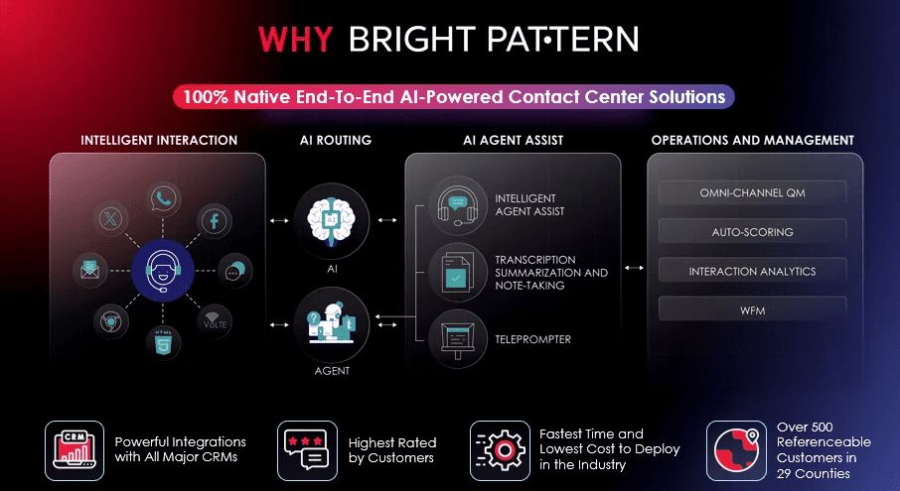
Bright Pattern is widely recognized as a top AI contact center platform that delivers seamless, personalized customer experiences across voice, chat, email, SMS, and social messaging. Its platform leverages voice bot artificial intelligence to handle routine inquiries, route interactions intelligently, and provide AI-assisted guidance to live agents, ensuring efficiency without sacrificing the human touch.
With Bright Pattern, businesses can implement predictive routing to connect customers to the right agent at the right time, reducing wait times and increasing first-contact resolution rates. The platform’s AI analytics provide deep insights into customer behavior, agent performance, and interaction trends, allowing continuous improvement of service delivery.Bright Pattern also supports omnichannel automation, enabling companies to maintain a consistent brand voice across all touchpoints. Its cloud-native infrastructure ensures scalability, high availability, and seamless integration with existing CRM systems and enterprise applications. Organizations using
Bright Pattern can easily scale their AI contact center operations to handle high volumes, seasonal spikes, or global expansion.Moreover, Bright Pattern emphasizes actionable insights and real-time monitoring, helping managers make informed decisions quickly. This combination of automation, AI assistance, and human-centered design allows businesses to enhance customer experience with AI while simultaneously improving agent satisfaction and operational efficiency. Whether you are a mid-sized business or a large enterprise, Bright Pattern positions your AI contact center as a strategic growth engine rather than just a cost center.
- Genesys Cloud CX
A top AI contact center solution with AI-powered routing, omnichannel engagement, and real-time analytics for improved customer experiences.
- Five9
Cloud-based AI contact center software offering automation, predictive dialing, AI-assisted agent workflows, and reporting.
- NICE inContact
Provides intelligent AI contact center solutions with predictive engagement, workflow automation, and advanced analytics.
- Talkdesk
An AI-first AI contact center platform delivering virtual agents, workflow automation, and real-time insights to optimize customer interactions.
- RingCentral Contact Center
Offers a scalable cloud AI contact center with AI-assisted interactions, seamless CRM integration, and multichannel support.
- 8x8 Contact Center
AI-powered AI contact center platform providing chatbots, omnichannel communication, and analytics for smarter customer engagement.
- Zendesk Sunshine Conversations
Supports AI contact center capabilities with AI-enhanced messaging, CRM integration, and personalized customer experiences.
- Avaya OneCloud CCaaS
Delivers an enterprise-grade AI contact center solution with virtual assistants, predictive routing, and cloud management.
- Cisco Webex Contact Center
Provides AI-driven insights, automated workflows, and multichannel support as a comprehensive AI contact center platform for enterprises.
Key Components of an AI Contact Center
Although AI contact center platforms differ in features and complexity, most share a common set of building blocks. Understanding these components helps you design an AI strategy that fits your business.
1. AI-Powered Virtual Agents & Chatbots
Virtual agentsand chatbots are conversational interfaces that can interact with customers through chat, messaging apps, or voice. They can:
- Answer common questions instantly (for example, order status or password reset).
- Guide customers through step-by-step troubleshooting.
- Collect information before handing off to a human agent.
- Operate 24/7, even outside your normal business hours.
Modern AI assistants understand natural language, not just rigid menus. They recognize intent, ask clarifying questions, and respond in conversational, brand-aligned language.
2. Intelligent Routing and Triage
Intelligent routinguses AI to direct each customer to the right resource, whether that is a virtual agent, a knowledge article, or a specific human agent with the right skill set.
Instead of routing based only on basic selections (such as pressing numbers on a keypad), AI can consider:
- The customer’s history and past interactions.
- Detected intent from their first question or message.
- Agent skills, experience, and current workload.
- Priority indicators, such as customer segment or issue severity.
The result is fewer transfers, shorter handle times, and more first-contact resolutions.
3. Agent Assist and Real-Time Guidance
Agent assisttools support human agents during live interactions. Rather than making agents search through multiple systems or knowledge bases, AI surfaces the right information at the right time.
Typical agent assist capabilities include:
- Real-time suggested responses or next-best actions.
- Automatic retrieval of relevant knowledge articles.
- On-screen highlights of key customer details.
- Live guidance for compliance, disclosures, or verification steps.
This not only speeds up each interaction but also reduces errors and helps new hires become productive quickly.
4. Self-Service Knowledge and Search
AI contact centers often integrate with or power a smartknowledge basethat customers and agents can search in natural language. Instead of rigid FAQ lists, AI-driven search can interpret the underlying question and deliver the most relevant answer.
Benefits include:
- Customers finding answers by themselves, without needing to contact support.
- Agents spending less time hunting for information.
- Consistent, up-to-date responses across teams and channels.
5. Analytics, Reporting, and Quality Management
An AI contact center generates a rich set of data from every interaction. Analytics tools can:
- Identify common reasons for contact (top drivers of volume).
- Monitor sentiment and customer satisfaction trends.
- Spot opportunities to improve products or processes.
- Automate parts of quality assurance by reviewing calls and transcripts.
Instead of making decisions based on guesswork, leaders gain a clear, data-backed view of customer experience and operational performance.
Key Benefits of an AI Contact Center
Implementing AI in your contact center delivers value on multiple fronts: customer experience, operational efficiency, cost optimization, and employee satisfaction. Below are the most impactful benefits organizations typically see.
1. Faster, More Convenient Customer Service
Many customers value speed and convenience as much as price. AI helps you deliver both by:
- Providing instant answers through virtual agents and self-service tools.
- Reducing time spent on hold and in queues.
- Offering consistent support outside traditional business hours.
- Making it simple to switch between channels without repeating information.
When customers can resolve routine issues in minutes, it frees your team to focus on more meaningful, high-value conversations.
2. Higher First-Contact Resolution and Accuracy
AI contact centers improvefirst-contact resolution (FCR)by connecting each customer with the most suitable resource from the start and ensuring agents have all the context they need.
AI-driven tools can:
- Automatically retrieve account details, order history, or past cases.
- Suggest tailored solutions based on similar interactions.
- Guide agents through structured troubleshooting steps.
The result is fewer follow-up calls, fewer escalations, and smoother experiences for both customers and staff.
3. Lower Operational Costs Without Sacrificing Quality
Running a contact center is resource-intensive. AI helps reduce costs by:
- Automating high-volume, low-complexity interactions.
- Deflecting routine contacts to self-service channels.
- Making agents more productive with better tools and guidance.
- Optimizing staffing by predicting demand patterns more accurately.
Importantly, this is not about cutting corners. When implemented well, AI allows you to reinvest savings into higher-quality human service where empathy and complex problem-solving matter most.
4. More Engaged and Empowered Agents
Agents often join customer service roles because they want to help people. However, they can easily burn out when bogged down by repetitive questions, complex tools, and constant pressure.
An AI contact center improves the agent experience by:
- Taking over tedious, repetitive interactions.
- Providing real-time support, suggestions, and context.
- Reducing manual after-call work with automated summaries and tagging.
- Giving agents more time to handle complex, meaningful issues.
As a result, agents feel more confident, more supported, and more satisfied with their work, which ultimately benefits your customers.
5. Better Insights for Smarter Business Decisions
Every conversation with a customer is a source of valuable insights. AI contact centers make it feasible to analyze this data at scale.
With AI-driven analytics, you can:
- Spot recurring pain points or product issues quickly.
- Understand which policies or processes cause friction.
- Identify training needs or knowledge gaps for your agents.
- Track the impact of changes on customer sentiment and satisfaction.
This intelligence helps you improve not only your contact center, but your entire customer journey.
Common AI Contact Center Use Cases
AI can support nearly every stage of a customer interaction. Below are practical, high-impact use cases that organizations commonly prioritize.
1. Automated FAQs and Account Support
One of the simplest and most effective entry points for AI is handlingfrequently asked questions. Typical examples include:
- Checking order or delivery status.
- Updating contact information or preferences.
- Resetting passwords or unlocking accounts.
- Providing basic product or service information.
These requests are usually straightforward, rule-based, and frequent, making them well-suited for virtual agents and chatbots.
2. Intelligent IVR and Voice Bots
Traditional IVR systems rely on rigid menus that can frustrate callers. AI-powered IVR and voice bots can understand natural speech, interpret intent, and route or resolve issues more efficiently.
For example, instead of pressing numbers, customers can simply say what they need, and the system:
- Identifies the reason for the call.
- Authenticates the caller securely.
- Decides whether to resolve the issue automatically or transfer to an agent.
This delivers a smoother, more human-like phone experience while still leveraging automation at scale.
3. Proactive Notifications and Outreach
AI can help you move from reactive support toproactive service. By analyzing patterns and events, your systems can trigger timely, relevant notifications such as:
- Order updates or delays.
- Appointment reminders and confirmations.
- Usage alerts or threshold warnings.
- Follow-up messages after a support interaction.
Proactive communication reduces inbound contact volume and shows customers that you are attentive and reliable.
4. Real-Time Translation and Localization
AI-powered translation can assist agents during live chats or calls, enabling them to support customers in multiple languages without needing full fluency in each one.
Benefits include:
- Expanding service coverage across regions and languages.
- Reducing the need for dedicated language-specific queues.
- Providing faster, more inclusive support to diverse customer bases.
5. Automated Call Summaries and After-Call Work
After each interaction, agents typically spend time documenting what happened. AI can listen to or read the conversation and automatically generate:
- Interaction summaries.
- Key outcomes and commitments.
- Tags, categories, and next steps.
This saves agents time, improves consistency, and ensures your CRM or ticketing system stays accurate and complete.
AI Contact Center vs. Traditional Contact Center
The table below highlights how AI contact centers compare with more traditional setups.
|
Aspect |
Traditional Contact Center |
AI Contact Center |
|
Customer Access |
Mainly phone and email, limited hours. |
Omnichannel (voice, chat, messaging, email) with 24/7 support options. |
|
Automation Level |
Basic IVR menus, simple scripts. |
Conversational AI, virtual agents, intelligent workflows. |
|
Routing |
Skill-based or queue-based routing only. |
Contextual routing using intent, history, skills, and priority signals. |
|
Agent Tools |
Manual search, multiple disconnected systems. |
Agent assist, unified views, real-time suggestions and guidance. |
|
Insights |
Sampling-based QA, limited reporting. |
Full interaction analytics, sentiment tracking, trend detection. |
|
Scalability |
Depends heavily on hiring and training more staff. |
Scales with demand via automation and smart capacity planning. |
Designing a Successful AI Contact Center Strategy
Launching an AI contact center is not just a technology project; it is a strategic transformation of how you serve customers. Below is a step-by-step framework to guide your journey.
Step 1: Clarify Your Vision and Goals
Before selecting tools or features, define what success looks like. Common objectives include:
- Improving customer satisfaction and loyalty.
- Reducing average handling time or wait times.
- Increasing self-service adoption.
- Enhancing agent productivity and engagement.
- Gaining deeper insight into customer needs and trends.
A clear, shared vision helps align stakeholders and guide trade-offs throughout your AI initiative.
Step 2: Map Customer Journeys and Pain Points
Walk through your customer journeys and identify where friction is highest. Consider:
- Moments when customers are most likely to contact you.
- Typical questions or tasks that repeat frequently.
- Stages where wait times or transfers are common.
- Interactions where human empathy and judgment are crucial.
This analysis highlights where AI can deliver the biggest improvement while respecting the need for human interaction.
Step 3: Prioritize High-Impact Use Cases
It is usually more effective to start with a focused set of use cases instead of trying to automate everything at once. Strong candidates include:
- Top-tier FAQs that are simple, frequent, and well-understood.
- Authentication and data collection at the start of interactions.
- Automated call summaries to reduce after-call work.
- Agent assist for complex but common issue types.
By delivering quick wins, you build confidence and momentum for broader AI adoption.
Step 4: Prepare Your Data and Knowledge Base
AI performs best when it has access to accurate, well-structured data. Focus on:
- Consolidating and cleaning customer data from different systems.
- Organizing knowledge articles and documentation.
- Standardizing key labels, categories, and workflows.
- Ensuring that privacy and data protection requirements are respected.
A strong data foundation greatly improves the quality and reliability of AI-driven interactions.
Step 5: Involve Agents Early and Often
Agents are central to AI success. Involve them by:
- Gathering their input on pain points and opportunities.
- Testing prototypes with frontline staff and collecting feedback.
- Positioning AI as a support tool, not a replacement.
- Providing training on new workflows and tools.
When agents feel heard and supported, they are more likely to embrace new technology and champion it with customers.
Step 6: Pilot, Measure, and Iterate
Start with controlled pilots before scaling. During pilot phases, closely monitor:
- Customer satisfaction and feedback.
- Resolution rates and handling times.
- Deflection rates from human-assisted channels to self-service.
- Agent productivity and sentiment.
Use these insights to fine-tune AI models, conversation flows, and routing rules. Continuous improvement is essential to unlocking the full value of your AI contact center.
Best Practices for AI Contact Center Success
Beyond the high-level strategy, certain practical principles consistently differentiate successful AI contact centers from average ones.
1. Preserve the Human Touch
AI is powerful, but customers still value human connection, especially in emotionally charged or complex situations. Design your AI experiences to:
- Offer easy, visible options to reach a human agent.
- Hand off to agents seamlessly, passing along the conversation history.
- Empower agents to override or adjust AI-driven decisions when needed.
This hybrid model blends the speed of automation with the empathy of human service.
2. Communicate Clearly With Customers
Set expectations by being transparent about AI usage. Customers usually respond positively when they understand:
- They are interacting with an automated assistant.
- What the assistant can and cannot do.
- How to quickly escalate to a human agent.
Clear communication builds trust and encourages customers to explore self-service confidently.
3. Design for Continuous Learning
AI systems improve as they are exposed to more interactions and feedback. Build feedback loops that allow your AI to learn, such as:
- Collecting ratings or short surveys after interactions.
- Allowing agents to flag incorrect suggestions or responses.
- Regularly reviewing transcripts to refine conversation flows.
Over time, these improvements compound, leading to more accurate, natural, and effective AI interactions.
4. Align With Governance, Privacy, and Compliance
Contact centers often handle sensitive information. When you introduce AI, ensure that:
- Data handling follows relevant regulations and internal policies.
- Access controls are in place for sensitive customer information.
- Audit trails and logs support compliance and quality checks.
Responsible AI practices protect your customers and your brand while enabling long-term innovation.
5. Measure What Matters to Your Business
Beyond traditional metrics such as handle time, focus on measures that reflect your strategic goals, for example:
- Customer satisfaction and sentiment across channels.
- Percentage of interactions resolved via self-service.
- Agent engagement and retention.
- Time to resolution for high-value or complex cases.
Tracking these outcomes helps you demonstrate the true business impact of your AI contact center.
Future Trends in AI Contact Centers
AI-enabled contact centers continue to evolve rapidly. Several trends are shaping the next generation of customer experience.
1. More Natural, Human-Like Conversations
Advances in large language models and speech technologies are making AI sound more natural and context-aware. This trend will enable virtual agents that:
- Handle more complex, nuanced interactions.
- Maintain context over longer conversations.
- Adapt tone and style to match your brand voice.
2. Deeper Integration Across the Customer Journey
AI contact centers will increasingly connect with marketing, sales, and product systems to create a unified view of the customer. This will make it easier to:
- Personalize offers and recommendations in real time.
- Trigger proactive outreach based on behavior and lifecycle stage.
- Share insights across teams to improve products and services.
3. Expanded Use of Predictive and Prescriptive Analytics
Beyond reporting what happened, AI will focus more on predicting what will happen and recommending the best actions. Examples include:
- Forecasting demand and staffing needs more precisely.
- Identifying customers who may be at risk of churn.
- Suggesting tailored retention or recovery strategies.
4. Stronger Focus on Responsible and Ethical AI
As AI becomes more central to customer interactions, organizations are paying greater attention to fairness, transparency, and accountability. Future-ready AI contact centers will:
- Offer clear explanations of AI-driven decisions when appropriate.
- Monitor for unintended bias in models and workflows.
- Include governance frameworks for model updates and approvals.
Building Your AI-Ready Contact Center Today
AI contact centers are no longer a distant concept; they are a practical, high-impact way to transform customer experience and operational performance right now.
By combining conversational AI, intelligent routing, agent assist, and powerful analytics, you can create a support operation that is:
- Always available and consistently responsive.
- Efficient and cost-conscious without sacrificing quality.
- Empowering for agents and enjoyable for customers.
- Rich in insights that guide smarter business decisions.
The most successful organizations start with a clear vision, focused use cases, strong data foundations, and open collaboration between technology teams and contact center leaders. From there, they iterate, learn, and gradually expand AI capabilities across channels and processes.
If you are ready to move beyond reactive support and build a modern AI contact center, now is an ideal moment to begin. With the right strategy and tools, every customer conversation can become faster, smarter, and more rewarding for everyone involved.
